If you are planning to bring a Korean webtoon or manhwa to Japan, one of the first decisions is: In what format should Japanese readers experience it?
One can retain the original vertical-scroll format and publish it in Japanese. One can also re-edit it into the page format familiar to manga readers for digital or print publication. Either way, replacing Korean dialogue with Japanese text is only part of the work. Language, text direction, speech-balloon shape, and reading order all need attention if the story is to read naturally.
Why localization matters in Japan’s digital comics market
Japan already has a substantial digital comics audience. According to WEBTOON Entertainment’s filings, its Japanese services, LINE Manga and eBookJapan, had approximately 22.2 million monthly active users in the fourth quarter of 2025. This is not a count of readers of Korean titles alone, but it illustrates the scale of the Japanese-language digital comics market.
For publishers and platforms holding Korean webtoon IP, the local reading experience matters as much as the content’s appeal. Even a compelling story can lose momentum if dialogue feels unnatural, text sits awkwardly in a speech balloon, or the reader’s eye is pulled in the wrong direction. Entering the Japanese market therefore calls for translation, editing, and design to be planned together.
According to WEBTOON Entertainment’s filings, its Japanese services, LINE Manga and eBookJapan, had approximately 22.2 million monthly active users in the fourth quarter of 2025.
Japanese webtoon translation must account for sentence length and scene rhythm
Accurately conveying the Korean text in Japanese is the starting point, but translators and editors must also consider forms of address, character relationships, genre-appropriate wording, and the length of dialogue at emotional moments.
In comics, the translated words become part of the artwork. A sentence may sound natural on its own but still need editing to fit and read well inside a speech balloon. At the same time, shortening it should not erase a character’s personality or an important detail. Webtoon and manga translation must balance linguistic accuracy with on-screen readability.
Japanese typesetting changes speech balloons and reading direction
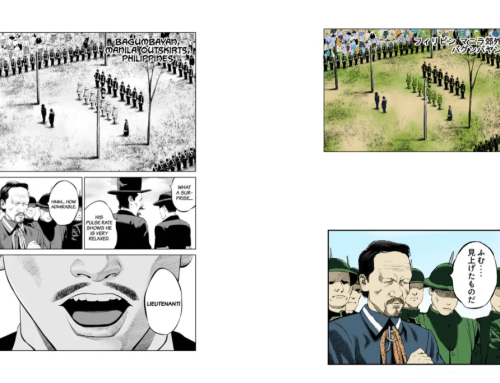
Before producing a Japanese edition, the publisher and production team need to decide whether to preserve the Korean original’s horizontal text and speech-balloon layout or adapt them to Japanese manga conventions, with vertical dialogue and a corresponding reading order. We generally recommend adapting the work to the Japanese vertical-text format, so the dialogue feels familiar and immediately comfortable for Japanese readers. This decision should be made early because it affects balloon shapes, text placement, and the flow of each panel.
In webtoons, readers scroll from top to bottom, but for Japanese webtoons dialogue and visual attention within a panel may still move from right to left. If the original balloon positions and dialogue order are left untouched, they may conflict with the intended Japanese reading flow. Depending on the work and the platform’s specifications, the team may need to reposition balloons, set text vertically, and adjust how the eye moves through each panel.
That is why webtoon and manga typesetting is more than replacing text. The appearance and position of words affect the pace and emotion of a scene.
Japanese Typesetting Details That Shape the Reading Experience
Ruby and furigana: which kanji need a reading guide?
A Japanese edition introduces an element that Korean webtoons generally do not need: ruby text, often called furigana when small kana are placed beside kanji to show how they are read.
Not every kanji needs furigana. A work for younger readers may call for extensive reading guides, while an adult title might use them only for difficult kanji, names, proper nouns, or unusual readings. The target age group and the publisher’s editorial standards should determine the approach, which must then remain consistent throughout the work.
Adding ruby is not simply a matter of inserting smaller characters. Especially on a mobile screen or in a narrow speech balloon, the team must check that there is room for the reading guide and that it remains legible when the image is reduced.
Japanese fonts and sound effects: how text style supports the story
Japanese uses kanji, hiragana, and katakana together. Typesetters must check that the selected fonts support every character the work requires and that missing glyphs do not cause an unintended mix of fonts. They should also verify that punctuation and other characters display correctly in vertical text.
Sound effects (SFX) deserve separate attention. In Japanese manga, their letterforms, size, angle, and placement convey the force of a sound and the mood of a scene. Using a dialogue font for SFX, or mechanically copying the shape of the original effect, may change the intended meaning. For example, the small tsu (っ in hiragana or ッ in katakana), known as sokuon, indicates a doubled consonant or an abrupt stop. It often appears at the end of Japanese manga sound effects and must remain distinct from the full-size つ or ツ. When designing an SFX, letterers should preserve its smaller size; enlarging it can change how the sound is read.
This is where knowledge of Japanese and manga design must come together.
Mechanically copying the shape of the original effect may change the intended meaning. For example, the small tsu (っ in hiragana or ッ in katakana), known as sokuon, indicates a doubled consonant or an abrupt stop. It often appears at the end of Japanese manga sound effects and must remain distinct from the full-size つ or ツ. When designing an SFX, letterers should preserve its smaller size; enlarging it can change how the sound is read.
Punctuation: the original marks do not always transfer directly
Japanese manga has punctuation conventions that localization teams need to consider. For example, changing ?! to !? may be necessary to follow Japanese manga convention. Japanese manga also conventionally omit commas inside speech balloons for a cleaner layout, often expressing the pause through extra spacing between characters or a line break instead.
The exact treatment should follow the publisher’s style guide and remain consistent throughout the work. Even small punctuation choices affect how naturally the Japanese edition reads.
From webtoon to page-format manga: adapting a work for Japanese publication
Another option to consider alongside Japanese localization is converting a vertical-scroll webtoon into page-format manga. Japan has a market for both printed comics and page-format digital comics that readers can access on smartphones.
According to Japan’s Research Institute for Publications, print accounted for 23.9% of the Japanese comics market by sales value in 2025. That does not mean 23.9% of readers chose print, but it shows that printed comics remain a meaningful part of the market. In a separate 2025 Oricon survey, 68.0% of surveyed digital comic service users named the feeling of reading a printed manga as an appeal of page-format digital comics. That figure describes an appeal of the format, not the share of people who read it. Together, these findings give publishers a reason to consider a page-format edition alongside a vertical-scroll release.
Publishers preparing a collected volume or page-based ebook need to arrange the original panels into pages. The job involves more than cutting panels to size and placing them together. Page turns can change the timing of a reveal; panels must work together in a right-to-left reading sequence; and the team must decide how to divide large scenes, place dialogue, and preserve or create double-page moments.
A Japanese edition that retains the vertical-scroll format calls for a different set of decisions: preserving scroll pacing while refining vertical Japanese text balloons and the reading direction within panels. Both approaches involve shaping the storytelling for its destination format. CCC’s manga verticalization and book-format conversion service supports these format-specific needs.
What publishers and localization companies should confirm before production
To define the Japanese edition’s scope and estimate its cost, it helps to settle these questions early:
- Publication format: Is the deliverable a vertical-scroll webtoon, a page-based ebook, a printed volume, or more than one format?
- Reading convention: Should we adapt the speech balloons and text for vertical Japanese writing and a right-to-left reading order, or preserve the original layout and let readers adapt to its reading direction—as many Western readers have done with manga?
- Japanese editorial standards: Given the target readers’ age, where should furigana be added, and what rules should govern fonts, sound effects, and punctuation?
- Production scope: Does the work include translation, editing, typesetting, sound effects, balloon changes, or panel rearrangement?
- Source files: Are editable files, such as PSDs, and the original script available?
- Delivery specifications: What resolution, file formats, page dimensions, and quality checks does the publisher or platform require?
The amount of work can vary considerably with the condition of the source files and the target format. Agreeing on translation, typesetting, and conversion choices through a sample episode or a few pages can make it easier to maintain consistency across later episodes or volumes.
Localization for Japanese readers requires comics production experience
A strong Japanese edition combines natural language with a page or screen that is easy to read. That calls for language specialists who understand Japanese nuance and a production team familiar with Japanese manga conventions, design sensibilities, and the practical work of changing pages, panels, speech balloons, and reading direction. Decisions about ruby, font coverage, SFX design, and punctuation also affect consistency across the work.
CCC supports Korean-to-Japanese webtoon and manga translation and localization, manga typesetting, and conversion between vertical-scroll and page formats. We can provide publishers with a connected Japanese-edition production workflow and support localization companies with the production stages they need.
Preparing a Japanese edition of a Korean webtoon or manhwa?
Share the source format, target platform, and work you need completed. We can review the most suitable approach to translation, typesetting, and format conversion with you. Contact us below.