How Modern Studios Adapt Sound Effects and Visual Humor to Preserve Storytelling Impact Across Global Markets
Key Takeaways
- Transcreation goes beyond translation: Adapting digital comics isn’t just swapping words. It involves reimagining sound effects, visual humor, and graphic cues so foreign readers experience the same emotional beats as the original audience.
- Onomatopoeia carries emotional texture: Sound effects in comics act as visual elements that dictate pacing and mood. Localizing them requires matching letterforms, line weight, and audio rhythm to the source artwork.
- Visual slang requires cultural decoding: Idiomatic art cues (like nosebleeds for arousal or sweat drops for embarrassment) often need subtle contextual shifts or visual tweaks to avoid confusing international audiences.
- Redrawing and retouching are critical: Professional studios combine clean art reconstruction with precise typography, ensuring localized lettering replaces original hand-drawn sound effects seamlessly without destroying the underlying artwork.
Beyond Direct Translation: Why Digital Comics Demand Transcreation
Digital comics have exploded into a global phenomenon. Readers from Seoul to São Paulo scroll through thousands of panels daily, devouring webtoons, manga, and digital graphic novels on their smartphones. However, bringing a comic to a worldwide audience involves much more than translating speech bubbles. The real challenge lies in the linguistic transcreation digital comics teams must perform to preserve narrative flow, tone, and visual impact.
Direct word-for-word translation frequently fails in sequential art. Comics are a deeply integrated medium where narrative text, visual art, typography, and graphic sound effects (SFX) work in unison. When a character gasps, a battle explodes, or a quiet moment unfolds under raindrops, the visual representation of those sounds carries narrative weight.
Transcreation bridges the gap between literal translation and creative adaptation. Instead of simply asking “What does this word mean?”, transcreators ask:
- What emotional response was the original author trying to evoke?
- How does this sound effect interact with the line art surrounding it?
- Will a reader in a different market understand this visual joke without extra context?
When studios invest in comprehensive webtoon translation and typesetting, they ensure that the localized edition feels as though it was originally drawn and written for the target language. By adapting cultural nuances, slang, and visual sound effects, studios protect reader immersion and keep the story moving without awkward interruptions.
Localizing Onomatopoeia: Adapting Sound to Pacing and Texture
Onomatopoeia in comics is also an art form, not just simple text. In Japanese manga and Korean webtoons, sound effects are drawn directly into the panel canvas, acting as dynamic components of the layout. Adapting these audio cues into English or other target languages presents both linguistic and artistic puzzles.
Sound Effects as Visual Architecture
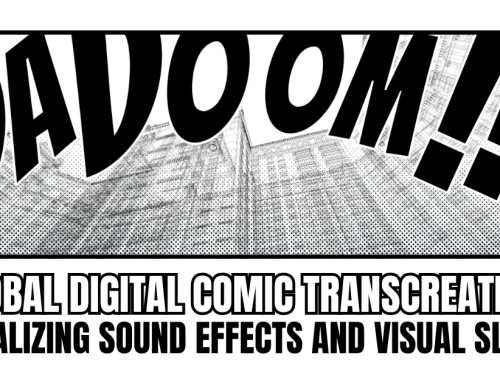
In traditional prose, a sound is described using words. In comics, a sound effect dictates action speed, spatial depth, and dramatic tension. A massive KABOOM with jagged red lettering feels heavy and destructive, whereas a tiny, thin drip conveys silence or loneliness.
Linguistically, languages categorize sound differently:
| Source Sound Concept | Japanese / Korean Style | Literal Meaning | Transcreated English SFX |
|---|---|---|---|
Quiet glance | Jiiiii (じー) | Staring intensely | Gaze… / Stare… |
Heartbeat / Nervousness | Doki Doki (ドキドキ) | Pounding heart | Thump Thump / Patter |
Smirk / Chuckle | Niya Niya (ニヤニヤ) | Grinning silently | Grin / Smirk |
| Awkward Silence | Caw Caw (Crow sound) | Bird call | … / Breeze… |
As shown above, many East Asian sound effects represent abstract psychological states or silent actions rather than audible sounds. A literal translation of Jiiiii as “Ji-i-i” makes no sense to an English reader. Transcreation replaces the literal phonetics with an English equivalent that fits the emotional beat. Sometimes, studios would use an action word like Stare or a localized sound cue like Glance.
Preserving Pacing and Lettering Texture
Beyond word choice, localized lettering must match the original artist’s visual rhythm. If the creator drew a broad, sweeping sound effect that spans three panels to emphasize a dramatic sword strike, the localized version cannot be a tiny, generic font slapped in the corner.
Typesetters must recreate the dynamic line weights, gradients, and textures of the original art. Achieving this seamless look requires specialized manga typesetting skills, blending typographic knowledge with digital brushwork so the new SFX feels like a natural part of the illustration.
Visual Slang, Cultural Tropes, and Narrative Tone
Comics rely heavily on visual shorthand, graphic tropes, and artistic slang that readers instantly recognize within a specific culture. When expanding to global markets, these visual cues can sometimes baffle new audiences if left unadjusted or uncontextualized.
Navigating Idiomatic Graphic Tropes
Every comic culture has its own visual language. Manga and webtoons rely on a rich vocabulary of stylized exaggerations:
- The Nosebleed: Universally understood in East Asia as a sign of romantic or sexual arousal, but occasionally confusing to uninitiated Western readers who might think the character has suffered sudden trauma.
- The Giant Sweat Drop: Indicates awkwardness, embarrassment, or exasperation.
- Popping Vein Markings: Symbolizes rising anger or impatience.
- Snot Bubbles: Signal deep, sleeping drowsiness.
Transcreation studios must decide how to handle these tropes based on the target audience. For mainstream global releases, typesetters can add text cues, dialogue adjustments, or subtle lettered additions to clarify the joke without altering the original artwork.
Adapting Tone and Local Humor
Humor relies heavily on wordplay, pop culture references, and regional slang. A pun that works brilliantly in Korean may fall completely flat when translated directly into English or Spanish.
In these instances, transcreators rewrite the joke from the ground up while preserving the character’s voice and the visual punchline. If a character points at a fish and makes a pun based on homophones in the source language, the localized dialogue must craft a brand-new pun that fits the visual image of the fish without disrupting the scene’s intent.
Practical Studio Workflows: Art Cleanup, Lettering, and File Management
Delivering localized digital comics on tight weekly schedules requires a streamlined, highly specialized production pipeline. Adapting hand-drawn SFX isn’t just changing text layers; it often requires reconstructive digital art.
The Art Reconstruction Phase
When original sound effects are removed from a comic panel, they often leave behind empty holes in character line art, background scenery, and complex textures. Retouch artists must meticulously redraw those hidden areas before inserting localized text.
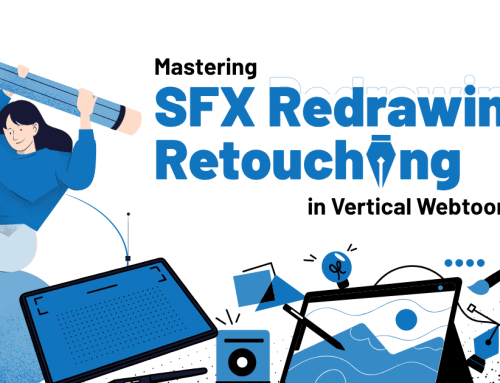
This delicate process demands advanced skills in mastering SFX redrawing & retouching in vertical webtoon layouts. Artists rebuild intricate backgrounds, apply matching digital brushes, and replicate screen tones so that the underlying artwork remains pristine beneath the new localized lettering.
Managing Complex Layer Files
Modern webtoons use long vertical scroll formats with hundreds of layered graphics per episode. Professional workflows demand strict file management:
- Source File Analysis: Separating dialogue bubbles, ambient sound effects, and core character art layers.
- Script Transcreation: Pairing translators with creative scriptwriters to balance accurate meaning with natural-sounding dialogue.
- Typography Selection: Choosing font families that reflect character personalities (e.g., erratic fonts for villains, clean sans-serif for main dialogue, custom brush fonts for SFX).
- Quality Control (QC): Reviewing side-by-side renders on mobile screens to ensure legibility, correct reading order, and pacing.
Scaling Global Comic Releases with Professional Localization
As digital publishing platforms expand worldwide, creators and publishers face the challenge of launching titles in dozens of languages simultaneously. Delivering consistent quality across simultaneous global releases requires a partner who understands both linguistic nuance and technical art production.
Working with an experienced localization agency like CCC lets publishers scale efficiently. Professional localization teams combine native linguistic mastery with veteran digital retouching expertise, ensuring every panel resonates emotionally with readers, regardless of where they live or what language they speak.
By treating sound effects, visual slang, and dialogue as interconnected elements of a unified artwork, linguistic transcreation transforms digital comics into truly global storytelling experiences.